 ;
;
(1)
1998 Yearly Report
Return to ArcView Tutorial 4: List of Topics
Alaska has abundant and diversified sport fisheries which are of considerable recreational importance to anglers and others (Howe et al. 1998). Approximately 15,000 water bodies in Alaska have been formally identified as supporting anadromous and resident fish species (ADF&G 1994). Many others have yet to be investigated.
Sufficient water of good quality is among the most essential requirements for sustaining fish productivity within Alaska’s fish bearing water bodies (e.g. rivers and lakes). Consequently, Alaskans are faced with the challenge of maintaining these conditions while satisfying needs for expanded municipal, community, and individual water supplies. Adding to this challenge are growing demands for water by private, government, and commercial developments, including the sale of water for export to other states and nations. Unless these increasing demands for and uses of Alaska’s waters are properly managed, they will harm fish production and other instream uses through unacceptable modifications to flow characteristics in rivers (instream flows) and water volume in lakes.
Fortunately, the Alaska legislature amended the Alaska Water Use Act (AS 46) in 1980 in recognition of the economic and social benefits that would be derived from retaining sufficient water in rivers and lakes. These amendments (AS 46.15.03 and AS 46.15.145) are referred to as the "instream flow law".
The instream flow law provided the opportunity for private individuals; in addition to state, federal, and local government agencies, to legally acquire water rights (appropriations of water) to maintain a specific flow rate in rivers (or level of water in rivers and lakes) for one or a combination of four types of uses:
Under Alaskan law (AS 46.15.145) and regulations (11 AAC 93.970), an appropriation of water for these purposes is also defined as a "reservation of water". Reservations of water can be described as the rate or volume of flow in a river, the volume of water in a lake, or a related physical attribute such as water depth. A reservation of water to protect flow related characteristics can also be called an "instream flow reservation".
Subsequent amendments to the Water Use Act related to instream flow protection were approved in 1982 and 1992. The 1982 amendments established formal mechanisms for adjudicating Federal Reserved Water Rights (instream flow and out-of-stream) under the jurisdiction of the Alaska court system. The 1992 amendments provided water export and sales criteria, including mandatory instream flow protection for water bodies used for water export. Regulations to implement the original 1980 instream flow law were adopted by the Alaska Department of Natural Resources (DNR) in September 1983. Additional regulations were promulgated in 1990 (Estes 1992), 1993 (Alaska Administrative Code 1993 a, b, c) and 1996 (Alaska Administrative Code 1996a, b) relating to the instream flow and other water rights application processes, application fees for water rights, conservation fees for water exports, and administrative fees associated with processing new and existing water rights.
To reserve water, an application containing supporting data and analyses that substantiate the need for the amount of water being requested must be submitted to the DNR for adjudication (the administrative determination of the validity and amount of a water right, including the settlement of conflicting claims among competing appropriators). Forms required to apply for reservations of water were first made available by the DNR in November 1983. Further information related to Alaska's instream flow water laws can be found in Curran and Dwight (1979), White (1981), Estes (1984), Estes and Harle (1987), Harle (1988), Estes (1987-1997), and Harle and Estes (1993).
The Fish and Game Act (AS 16) requires the Alaska Department of Fish and Game (ADF&G) to, among other responsibilities, "…manage, protect, maintain, improve, and extend the fish, game and aquatic plant resources of the state in the interest of the economy and general well-being of the state" (AS 16.05.020). AS 16.05.050 enables the ADF&G to acquire water rights to further its objectives or purposes. The Division of Sport Fish of the ADF&G initiated an ongoing program in 1986 to take advantage of the new opportunity to acquire instream flow water rights for sport fishery resources and related instream uses.
This report summarizes the 12th year of this program (July 1, 1997 to June 30, 1998) in which the primary objective was to estimate seasonal quantities of instream flows necessary to sustain sport fishery resources in four stream reaches. The status of instream flow related activities of other agencies and the private sector is also provided and supplemented by relevant summaries of Alaskan legislation, regulations, and administrative actions.
Procedures for site selection, instream flow analysis, and completing applications for instream flow reservations were selected to comply with requirements established by state law (AS 46.15.145), state regulations (11 AAC 93.141-146), reservation of water application form instructions (Estes 1993), and the State of Alaska Instream Flow Handbook (DNR 1985).
Four water bodies (Figure 1; Appendices A1-A4) were selected for instream flow analyses and preparation of instream flow reservations in Fiscal Year 1998 (FY 98, July 1, 1997 to June 30, 1998): Karluk River, Kvichak River, Newhalen River, Wood River.
Water bodies were nominated and selected following procedures in the 1984 Departmental Instream Flow Work Plan (ADF&G 1984, Estes 1985), and as modified in 1986 (Instream Flow Committee 1986).
Final selections of a water body and portions of water bodies to be reserved site were made by the Statewide Instream Flow Coordinator in consultation with Regional Supervisors for each region of the Division of Sport Fish or designees. Selections were based on the importance of a water body to the sport fishery resources, the likelihood for competing out-of-stream uses, whether existing hydrologic and biologic data for a stream reach were adequate for performing an instream flow analysis (including the subsequent preparation and submission of an application), and whether other state and federal statutory mechanisms would provide better or more cost effective protection than an instream flow water right acquired under Alaskan law.
Stream reach boundaries for each FY 98 instream flow application were selected to insure that flow, habitat, and fish periodicity (seasonal use of habitat for passage, spawning, incubation, and rearing) characteristics within the reach were relatively uniform throughout the study reach.
Reaches were defined on U.S. Geological Survey (USGS) topographic maps with the assistance of ADF&G biologists and USGS hydrologists. Topography, watershed, and channel patterns, fish periodicity, USGS gage site descriptions and mean daily flow data were collectively analyzed.
Fish periodicity data for defining stream reaches and flow requirements were obtained and summarized from reviews of scientific literature, interviews with fishery and habitat biologists from the ADF&G and other agencies, the Catalog of Waters Important for Spawning, Rearing, or Migration of Anadromous Fishes (ADF&G 1994), and Harvest, catch, and participation in Alaska sport fisheries during 1996 (Howe et al. 1997).
ADF&G biologists (responsible for the areas encompassing targeted instream flow reaches) reviewed and refined the syntheses of periodicity data. If discrepancies were discovered among data sources for species distribution and life phase occurrence within a reservation reach area, individuals responsible for data sources were consulted to reach a consensus as to which data to use. The final periodicity chart was based on these consultations.
Flow data and gage site descriptions used for delineating reach boundaries were obtained from USGS Water Resources Data for Alaska reports; and from interviews with ADF&G biologists, USGS hydrologists, DNR Division of Mining and Water hydrologists and water resource specialists, and other resource specialists that are known to have data pertinent to the reservation.
Alaska water laws and regulations required that stream reach boundaries encompassed a stream reach with homogeneous flow and biologic characteristics. Boundaries were first determined by evaluating watershed and channel characteristics upstream and downstream of a stream gage or discharge site.
Seasonal fish distribution and species periodicity were used to refine reach boundaries that were hydrologically defined. The resulting selection of boundaries were then refined based upon reviews by USGS hydrologic personnel and ADF&G’s regional biologists.
An applicant's choice and use of a specific method for quantifying instream flow requirements is not restricted by existing Alaska water laws, regulations, or a set of established standards (DNR 1985, Estes and Harle 1987, Alaska Administrative Code 1993a). However, the rationale for the selection of a method or methods must be documented and include a description of the procedures. This information must accompany the resulting instream flow application.
The Tennant Method, also referred to as the Montana Method (Tennant 1972, 1976), was selected as the primary basis for quantifying instream flow requirements for the FY 98 study sites. The Tennant Method analysis was combined with an evaluation of mean daily flows, mean monthly flows, duration flows, and other hydrologic characteristics (Orsborn and Watts 1980, Estes 1984, Estes and Orsborn 1986, Shaw 1988). The combined analyses were used to determine whether sufficient water could be expected to be within each study reach during the various periods of the year in which the reservation was requested, and to enable a refinement of the instream flow choices derived with these analyses.
USGS surface water flow data, required for performing all of these analyses, were obtained from local USGS computers, USGS annual reports, and USGS staff. Each data set was transferred into Statistical Analysis System (SAS) data files (SAS 1990). Summary analysis was used to check the data for simple errors.
After initial error checking was complete, the data were analyzed by a series of SAS programs using the procedures outlined below to estimate the long-term average annual and average monthly mean daily flow values and the monthly (and/or semi-monthly) flow duration parameters.
Descriptive information pertaining to the fishery and hydrologic characteristics of the study sites were acquired through literature review and interviews with ADF&G’s biologists, USGS’ hydrologists, the DNR’s Division of Mining and Water hydrologists, and other state, federal, and private resource specialists that were known to have data pertinent to the reservation analyses.
ADF&G biologists and USGS hydrologists, most familiar with each study site, assisted with the refinement of this information whenever discrepancies occurred.
The choice of the Tennant Method was based on its acceptance by both the DNR and Alaska courts as a valid instream flow analytical procedure (Supreme Court of Alaska 1995), and the limited availability of data, previous analyses, and financial resources required to prepare instream flow applications.
The first step of the Tennant Method was to calculate the average annual flow, QAA, (arithmetic mean of the annual mean of mean daily flows for all years of record) for each stream reach.
Next, each QAA was multiplied by eight Tennant Method coefficients (percentages) to calculate instream flows for eight habitat categories.
Seven of the Tennant Method habitat categories (ranging from 10% to 100% of the QAA) represent a range of poor to optimum habitat quality conditions for fish and wildlife.
The eighth category (200% of the QAA) represents the short-term flushing flow that Tennant (1972) considers necessary to maintain channel substrate characteristics suitable for fish spawning and egg incubation, and benthic invertebrate production. Research by Estes (1984, Reiser et al. 1985) suggests supplemental analyses are required to modify or substitute for Tennant Method flushing flow calculations.
Next, hydrologic analyses were performed to estimate baseline flow conditions in each stream reach. This involved calculating mean monthly flows (QAM), the arithmetic mean of the monthly mean daily discharge for a given month for the entire period of record, and flow duration estimates (the frequency of occurrence of mean daily flows within a particular month).
Finally, seasonal instream flow requirements for individual life phases of fish for each stream reach were chosen by comparing the eight Tennant Method flows, fish periodicity data, QAM, and flow duration estimates. With the exception of flushing flows, instream flows were selected that corresponded to both fish periodicity and the highest of the other seven Tennant Method habitat categories that did not exceed flow duration estimates during that same period.
During the months when spawning occurs, flows within the highest qualitative instream flow condition were selected from the Tennant analysis output that did not exceed those estimated by other hydrologic analyses (i.e. mean monthly flow or duration analysis values) during that same time period.
During other life phase time periods, the highest of the flows were selected that were expected to occur within the system during that time period that fell within the Tennant ranges of "fair to excellent".
When more than one life phase occurred for the same or different species during the same time period, the life phase for that time period requiring the highest instream flow value were requested for that time period.
A flushing flow calculation was calculated as part of the Tennant Method analyses, but not used to file for a flushing flow water right due to provisions in the Water Use Act (AS 46.15.145) that are interpreted by the DNR to limit reserving this type of flow to water bodies with controlled flows. Resources were unavailable to perform supplemental flushing flow analyses recommended by Estes (1984) for refining and supplementing flushing flow results derived by using the Tennant Method.
Average Annual Flow Procedures
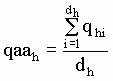
Calculation of QAA, from the existing USGS mean daily flow records for the stream reaches, involved first obtaining the mean of the mean daily flows within each water year (October 1-September 30):
|
|
(1) |
where: qaah equaled the mean annual daily flow for each year (h) of record; dh equaled the number of days in each year of record (note that only complete years of record were used in this analysis; dh varied only between leap and non-leap years); qhi equaled the daily mean flow in cubic feet per second for each day in the record.
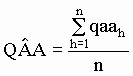
Next, QAA was estimated as a mean of the annual mean daily flow values over all complete years of record:
|
|
(2) |
where: n equaled the years of record (with complete daily flow records for each water year).
The QAM was estimated similarly by first estimating the mean daily discharge for each complete month in the record:
; (3)
where: qamjh equaled the monthly mean daily flow for each month (j) for each year of record (h); djh equaled the number of days in each month of record (note that only complete months of record were used in this analysis); qjhk equaled the daily mean flow in cubic feet per second for each day in the record.
Next, QAM was estimated as a mean of the monthly mean daily flow values over all complete years of record:
; (4)
where: nj equaled the years of record with complete daily flow records for each j.
Flow duration estimates were calculated as percentiles of the distribution of observed values within the time periods involved over the years of record. For example, flow duration estimates for the month of April were calculated by combining all mean daily flow values for April (for all years having complete April records). Then the empirically defined distribution (observed-combined mean daily flow values) was calculated as follows. If the quantity to be calculated was defined as the "tth" percentile, where p = t / 100, then setting:
np = j + g
where: n was equal to the number of observed mean daily flow values in the combined group (for example 300 days for a 10 year- record of complete months of April); j was the integer part of n times p; and g was the fractional part of n times p. For example, if n = 300 and we wanted to calculate the 97th percentile, then j = 291 and g = 0; or for the 2.5th percentile, then j = 7 and g = 5.
Then the tth percentile (y) was defined as:
if g = 0; (5a)
or
= x(j+1) if g > 0; (5b)
where: x(j) and x(j+1) were the ordered (from smallest to largest) values in the combined group of mean daily flow values.
The above and other legally required information was combined and used for preparation of instream flow applications following procedures defined by state law, state regulations, and other administrative requirements (ADNR 1985, Estes 1993, Harle and Estes 1993).
Analyses were completed and applications prepared to request instream flow protection for fish in four stream reaches in four river systems (Figure 1; Appendices A1-A4; ADF&G 1998a, b, c, d): Karluk River, Kvichak River, Newhalen River, and Wood River. Applications are undergoing normal review prior to submitting them to the DNR.
The lengths of the five stream reaches, ranged from approximately 21 miles (Wood River, Appendix A4) to 62 miles (Kvichak River Appendix A2).
Fish periodicity for each stream is illustrated in Appendices A5-A8. Karluk River (Appendix A5) had the lowest variety of fish species reported (8) and Newhalen River (Appendix A7) had the most species (22). Appendix A9 lists the common and scientific names of the fish species listed in the periodicity charts (Appendices A5-A8).
Historical records of USGS mean daily flow data varied from five years of record for Karluk River to twenty-one years for Newhalen River (Appendix A10).
QAA, mean monthly flow, and Tennant Method results are summarized in Appendices A11-A14. QAA values ranged from 418 cubic feet per second (cfs) for Karluk River (Appendix A11) to 17,854 cfs for the Kvichak River (Appendix A12). Mean monthly flows ranged from 237 cfs in Karluk River during March (Appendix A11) to 26,819 cfs in the Kvichak River during September (Appendix A12). Optimum habitat flows ranged from 251-418 cfs for Karluk River (Appendix A11) to 10,712-17,854 cfs for Kvichak River (Appendix A12) . Poor habitat flows ranged from 42 cfs for Karluk River (Appendix A11) to 1,785 cfs for Kvichak River (Appendix A12). Tennant flushing flow values ranged from 836 cfs for Karluk River (Appendix A11) to 35,708 cfs for the Kvichak River (Appendix A12).
Instream flow values requested usually ranged from 60% to 100% of the QAA for the spawning and passage seasons, and 10% to 40% of the QAA for incubation and rearing seasons (ADF&G 1998a, b, c, d).
There is presently no legal mechanism for reserving flushing flows in unregulated streams and rivers in Alaska. Research by Estes (1984) suggests flushing flow calculations, using the Tennant Method, require additional analyses that were not funded. Therefore, Tennant values were not modified and used for reserving flushing flows for the four river reaches.
A flushing flow statement was included in each instream flow application to establish a basis for protecting flushing flows in these unregulated systems (until an acceptable method is developed for use under state law). The statement explained that flushing flows were required to maintain fish habitat and (at a minimum) must be safeguarded whenever significant flow modifications or a structure capable of controlling flows were planned.
Instream flow regimes requested are not included in this report because they are subject to modification both while undergoing departmental review prior to submission to the DNR and during the various stages of the DNR adjudication process. These data will be presented in future reports following the completion of these processes. Past experiences indicate DNR’s adjudication of reservation of water applications (filed by the ADF&G and other applicants) is often delayed several years beyond the time of application submittal.
Between 1980 and December 1998, the DNR received a combined total of 237 applications for reservations of water (under AS 46.15.145) from the ADF&G, federal agencies, and private sector (Appendix A15, Estes 1987-1997, Harle 1988, Harle and Estes 1993; Keith Bayha, U. S. Fish and Wildlife Service, USFWS, Anchorage, personal communication, Mary Lu Harle, USFWS, Anchorage, personal communication, Bernice Sterin, U. S. Bureau of Land Management, BLM, Anchorage, personal communication).
Not including the 1998 ADF&G applications, 76 instream flow applications have been completed by the ADF&G (75 for rivers and one for a reservation of water in a lake), four by the BLM, 152 by the USFWS (12 rivers and 140 lakes), eight by the non governmental (private) sector (four by the Anchorage Audubon Society, two by private individuals, one by the Arctic Unit of the Alaska Chapter of the American Fisheries Society (AFS), and one by the Juneau Chapter of Trout Unlimited (TU).
Six of the private applications (four Audobon and two applications completed by private individuals) were rejected by the DNR in the early 1980s for a variety of reasons and are therefore not represented in Appendix A15. (Estes 1993, Harle and Estes 1993). One of the BLM and 10 of the ADF&G applications for instream flow reservations have been adjudicated and granted by the DNR (Estes 1994).
No ADF&G pending applications for reservations of water have been completely processed and granted since 1990. Adjudications for two of the ADF&G’s applications were initiated in 1996 (Estes 1996), 15 more on June 30, 1997, and one more in the fall 1998. Seventeen of these adjudications in progress were initiated by the DNR as part of an 18-month project (that began in January 1996) to adjudicate all classes of pre-1996 water rights applications (Estes 1996). The ADF&G has been unable to address these unexpected adjudications because only one person has been funded by the program to file for instream flow reservations and perform other related duties.
While DNR attempted to reduce its pre-1996 backlog, all water rights applications filed after December 31, 1995 were added to a new backlog unless a special exemption for an expedited review was obtained by an applicant. Although the backlog project was to end on June 30, 1997, an estimated 200 pending pre-1996 water rights applications, (including the 17 ADF&G adjudications in progress) and approximately 1,500 administrative actions remain to be processed and/or completed. Another adjudication was initiated by the DNR in 1998 in response to a request for an expedited review by an out of stream appropriator. It too has not been completed.
A schedule has not been established by the DNR for addressing the other remaining ADF&G applications pending adjudication by the DNR (Estes 1992-1997, Harle and Estes 1993). Some of the pending ADF&G applications were filed 10 years ago.
Efforts were made to resolve water rights claims for the Indian River Basin in Sitka. This basin is also subject to Federal Reserved Water Rights (FRWR). Although a reservation of water has been granted to the ADF&G, it is junior to other water uses and will not protect fishery resources unless other senior water rights are adjusted to provide seniority to the ADF&G water right. This particular instream flow water right was filed by the ADF&G in response to a request by the DNR for ADF&G assistance to help settle water rights disputes in the Indian River basin.
Other Reservation of Water Categories
Two instream flow reservations were granted by the DNR (under AS 46.15.035) in 1996 as part of the adjudication process for a water right application filed by the City and Borough of Sitka to export water from Blue Lake. Water exports require mandatory reservations of water with a 1992 priority date to protect fish resources (Estes 1992, 1996, Harle and Estes 1993) per 1992 amendments to the Alaska Water Use Act (AS 46.15.035 and AS 46.15.037).
Obstacles to Current and Future Protection
More than 15,000 fish bearing freshwater bodies (ADF&G 1994) are potentially subject to water extraction and flow modification in Alaska. Thus, it is not surprising the Alaska Legislature and Governor approved amendments to the Alaska Water Use Act in 1980 to allow for the formal reservation of water (AS 46.15.145) for, among other reasons, to help sustain the production of Alaska’s invaluable fishery resources in rivers and lakes. To qualify for water rights protection under AS 46.15.145, many of these 15,000 fish bearing rivers must be subdivided into five or more individual instream flow reservation reaches. Each of these reaches will require a separate instream flow reservation application. Therefore by multiplying the 15,000 anadromous water bodies by a conservative estimate of only four reaches equals 60,000 potential instream flow reaches requiring protection. The ADF&G continues to question why less than 100 river reaches and 141 lakes (out of an estimated 60,000 or more fish bearing river reaches and over a million lakes) have been targeted for formal instream flow and related protection during the past 12 years (Estes 1987-1997). And of the applications for reservations of water filed and accepted, why have so few been granted; and, why are the remainder pending adjudication? There are several reasons; among them are: insufficient allocations of personnel and financial resources needed for performing application and adjudication functions related to the reservation of water, insufficient hydrologic data required for defining water availability and instream flow requirements, lengthy administrative processes for preparing and adjudicating applications for water reservations, insufficient public education relating to instream flow and other water reservation protection opportunities, and except for state agencies, reservation of water application fees (Estes 1993, Harle and Estes 1993).
The dearth of hydrologic data in Alaska continues to be perhaps the most limiting factor governing our ability to define instream flow and other water uses. Although Alaska has approximately 40 percent of the nation's surface freshwater supply (Harle and Estes 1993), only 456 USGS continuous flow stream gaging sites have been established in Alaska since 1908 (Meyer 1998). This equates to flow measurements for less than 1 percent of Alaska's water bodies. Eleven of these Alaskan gage sites have less than 1 year of continuous flow data, thirty-five have 1 year of continuous flow data, eighty-nine have 1 year to less than 5 years of continuous flow data, seventy-eight have 5 to less than 10 years of continuous flow data, one hundred-twenty-seven have 10 to less than 20 years of continuous flow data, one-hundred-nine have 20 to less than 50 years of continuous flow data, and seven sites have 50 or more years of data (Appendix A16).
Seventeen percent, or 78 of the 456 gages established in Alaska, were operational during Water Year 1998, October 1, 1997 to September 30, 1998. Typically, no more than 20 percent of the total number of Alaskan gages are active in any one water year due to funding restrictions (Estes 1991-1997, Brabets and Hawkins 1995, Brabets 1996, Meyer 1998).
The 78 gages operating during Water Year 1998, represents an average of approximately one stream gage per 7,500 square miles in Alaska. Alaska’s density of gages contrasts significantly with the lower 48 states’ average of one gage site per 400 square miles.
It should be noted that similar USGS historical data summaries for Alaska reported by this report series in prior years (Estes 1987-1997) were recently found to be incomplete (Dave Meyer, USGS, Water Resources Division, Anchorage, personal communication). As a result, the data reported in this year's report (Appendix A16) have been corrected and should not be compared directly with prior summaries of similar types of data reported previously by this report series (Estes 1987-1997). Errors in the summary data submitted by the USGS to the ADF&G in past years were identified by a USGS project to automate their historical index of streamflow data for Alaska. The data for 1998 (presented in this report) do not alter prior conclusions (Estes 1987-1997) regarding the dearth of historical flow data available for instream flow and other water rights and other assessments of these data for the majority of waterbodies in Alaska.
The stream gaging trend in Alaska is especially alarming, even for the limited number of gage sites that have been established. As of September 30, 1998, only 53 percent or 243 of the 456 Alaskan gage sites (Appendix A16) could meet the USGS 10 year-minimum historical data standards for supporting a statistically reliable regional flow analysis. Daily stage and water surface elevation data are also non-existent for the majority of Alaskan lakes.
The limited availability of real-time and historical hydrologic data for Alaska has resulted in the majority of requests for withdrawing and impounding water or acquiring instream flows being based on estimates of flows. To estimate flows, one must use regional hydrologic models and/or extend limited data bases through correlation with a limited number of longer-term sites. In the absence of long-term data, it is obvious the USGS databases, from which these models were developed, limit the ability to evaluate naturally occurring hydrologic patterns at ungaged sites (and sites with limited historical flow data) with confidence.
It is more time consuming to estimate flow characteristics for streams having a limited or non-existent database as opposed to summarizing data for a stream having an adequate historical record. Precipitation information also required for these ungaged flow models is also limited, further complicating the process for estimating flow availability. Similar data limitations hamper efforts to quantify water reservations for lakes.
Basic hydrologic data are required by all potential water users (out-of-stream and instream), and water management agencies to enable them to project the reliability and amount of water that might be available, even if there were no other competitors for their targeted water source. Continuous flow and stage data are also necessary to manage and enforce existing water rights.
Limited road systems, extremes in weather conditions, and difficulties such as loss of equipment to bears and other wildlife make data collection difficult and expensive in Alaska.
It should be obvious that additional gaging stations should be added for a minimum of 10 to 20 years to improve the accuracy of the information used to make decisions pertaining to water availability and allocation in Alaska. Unless a commitment is made to close these data gaps in Alaska, we will continue to be limited to making decisions regarding water allocation using these models with little or no hope for improving the precision or accuracy of our flow estimates.
Over the past 12 years, the ADF&G devised a strategy to enable it to quantify instream flow needs for fish with limited hydrologic and biologic data. This strategy has enabled the ADF&G to partially compensate for the limited availability of financial and personnel resources allocated by the department for collection and analysis of instream flow data needed to acquire and protect instream flows.
To compensate for these limitations, the ADF&G has developed and refined a cost-effective approach to acquire the majority of its instream flow protection for fish by using the Tennant Method as its primary technique for analyzing instream flow needs. When necessary, this method has been modified and new procedures (requiring minimal resource expenditures) have been developed (Estes 1989, 1992) to request specialized instream flow and related reservations of water (e.g., flushing flows, and water depth and area in lakes).
As a rule, uses of more sophisticated and expensive methods for reserving water, such as the Instream Flow Incremental Methodology (Bovee 1982) have been limited to situations where competition between out-of-stream uses and instream related requirements was likely to be highly controversial and required an incremental quantitative flow analysis.
Projects under federal jurisdiction (e.g., projects requiring a Federal Energy Regulatory License, FERC) have occasionally mandated a specific data collection and analytical procedure. Basin wide adjudications for quantifying Federal Reserved Water Rights may also require the use of more costly data collection and analysis processes.
Unfortunately, supplemental funding, available in the past for projects requiring application of more sophisticated methods, has become increasingly difficult to obtain. Funding has also been unavailable to systematically evaluate whether reservations of water have been providing the desired protection and to monitor whether water uses have been in compliance with governing appropriations.
Duration of Administrative Processes
Administrative processes can be an added deterrent to potential and existing applicants, for reservations of water, including the ADF&G. Based upon past experiences, an estimated 1- to 3-weeks of an applicant’s time may be required to participate in the various phases of the DNR adjudication process for each outstanding instream flow application (Estes 1994).
Adding to an applicant’s frustration, is the absence of a fixed timetable for the DNR to adjudicate water rights applications after they are filed. There have been no completed adjudications of the ADF&G’s and other applicants’ pending applications for reservations of water (filed under AS 46.15.145) since 1991 (Estes 1992-1997, Harle and Estes 1993). However, under AS 46.15.035 and .037, the DNR recently granted two mandatory reservations of water required by 1992 water export amendments to the Water Use Act (Estes 1996). And as noted above, the adjudication of 18 of ADF&G’s pending reservation of water applications, (17 as part of the former DNR backlog project), has been initiated by the DNR.
The DNR’s variable schedule for processing water rights applications for instream flow and other water reservations, and the overall backlog of water rights actions by the DNR adds another obstacle and level of difficulty. The unscheduled initiation of the adjudication of so many former applications at once cannot be accommodated under the existing ADF&G program.
Prior to 1996, DNR’s water rights application backlog was estimated to have been growing at a ratio of approximately one reservation of water application per ten applications for out-of-stream water rights.
Complicating the adjudication of the DNR backlog are water rights for out-of-stream uses that were grandfathered by the DNR in 1966. Many of these water rights were granted without identifying whether the quantity of water claimed by an applicant actually existed, was needed, or used. This may have resulted, or will result, in overappropriations from some of the affected water sources.
DNR’s eventual adjudication of its backlog of applications for out-of-stream uses of water (derived from or affecting fish bearing water sources) could provide another type of opportunity for instream flow and related protection if sufficient resources are available to review each water right application and identify instream flow needs.
This is because under AS 46.15.080 (b)(3), the DNR is required to provide the ADF&G the option to review any proposed water use that may affect fish and wildlife production. The ADF&G can, based upon its review, request the DNR to condition (revise or deny) an applicant’s proposed out-of-stream water use for the purpose of protecting fish and wildlife.
On the other hand, the timing for adjudicating these out-of-stream water rights has already strained ADF&G’s instream flow and other program resources (similar to concerns expressed above associated with reservation of water adjudication processes).
The potential benefit of conditioning a consumptive water use or a water use that modifies flow characteristics must be considered because the unallocated water, resulting from a DNR condition placed on a water right (in consideration of a request from the ADF&G), remains subject to future appropriations. This is because the DNR is only required to consider the input of the ADF&G, and can accept, modify, or ignore the ADF&G’s recommendations under this provision.
Findings of Fact and Conclusion of Law Documentation
An absence of standards governing how the DNR documents its rationale for adjudication decisions under AS 46.15.080 further weakens instream flow related considerations under these provisions. This was further emphasized in court litigation challenging an adjudication determination by DNR (Supreme Court of Alaska 1995).
Inadequately documented decisions for denying or reducing the amount of water granted to an applicant for an out-of-stream use (in response to a request from the ADF&G) may result in future DNR adjudicators inadvertently interpreting that the remaining unallocated water in a water body remains subject to allocation, when in fact, a public interest decision had been previously made for purposes of instream protection.
This record keeping problem would be solved if the DNR were to adopt findings of fact and conclusions of law procedures for all water rights applications. Presently, this process is only mandatory for reservation of water adjudication decisions (11 AAC 93.0145).
These were among the reasons AS 46.15.145 provisions were enacted to establish a formal mechanism for allocating water rights for instream flows and other reservations of water (Harle and Estes 1993). Accordingly, it is in the best interests of the ADF&G to closely monitor the DNR’s future plans for adjudicating their large backlog of out-of-stream water rights and completing other pending water allocation related administrative actions.
The growing backlog of the ADF&G’s applications for water reservations pending adjudication has, until recently, not been interpreted to pose an immediate threat to desired instream flow and related protection. This is because a priority date was assigned to each application for a reservation of water at the time it was accepted by the DNR.
The priority date establishes the order of priority for the allocation of water within and from the source of water. However, until the adjudication process is completed, the amounts of water requested in applications for water reservations and out-of-stream water uses remain subject to modification or rejection by the DNR.
Until recently, this principle has been applied consistently. Thus, until an instream flow or reservation of water right application has been fully adjudicated, it is assumed 100% of the original amount of water requested in the application will be managed by the DNR on behalf of the applicant.
The ADF&G has become increasingly concerned as more time passes before an application for a reservation of water is adjudicated. This is because it is more likely that those responsible for the original instream flow and water reservation analyses and application preparation, and the DNR staff who completed the initial phases of an adjudication will have changed employment or responsibilities. It is also conceivable that out-of-stream competition for water from sites pending adjudication of previously filed applications for instream flow and other reservations of water will increase over time.
Experiences gained by other states indicate that protection of instream flow and other reservation of water uses is often judged to be less important than allocating water to competing out-of-stream water uses when competition for water allocation is keen.
Accordingly, there is a danger that lengthy delays in adjudicating applications for reservation of water uses may result in less than desired protection than would otherwise be granted today (while competition from other out-of-stream water uses remains minimal).
Another limitation of existing water management practices, is the DNR policy of not managing water diversions when water is not used. For example, this applies to a water body that has been diverted without putting the water to use before returning the water to the original water source at the same or different location from the initial point of diversion.
The DNR claims they have no water management authority for this type of diversion unless someone possesses a prior water right for instream flows or water extraction within the river reach that was diverted. The DNR bases its position on the belief that they cannot manage the water unless it is put to a beneficial use (even if fish were identified as using the reach from where the water was diverted).
This DNR policy could result in the dewatering of portions of fish bearing waters, unless the ADF&G were notified of the water diversion and exercised its AS 16.05.840 and 870 authorities.
Fees charged by the DNR for filing instream flow and other reservation of water applications are another deterrent for applicants. With the exception of state agencies, all applicants seeking to acquire a reservation of water are charged $500 per application (Alaska Administrative Code 1993b). There is no charge to state agencies.
The $500 fee is expensive relative to application fees charged by the DNR for most other water rights and (unlike other water rights) is not based on the amount of water requested. Although the USFWS has provided DNR $76,000 in filing fees for its 152 pending instream flow applications, the DNR has not adjudicated any the USFWS instream flow applications.
An additional regulatory fee was adopted by the DNR in 1993 (Alaska Administrative Code 1993c). It enables the DNR to charge for the cost of staff time expended on the adjudication of water rights that exceeds the application fee. This supplemental fee is discretionary and serves as another obstacle for filing instream flow and other reservation of water applications by the private sector, and perhaps federal agencies.
The above factors, and the complexity of water law and regulations, all contribute to the low number of applications filed for reservations of water.
Some of the above and related concerns have and are still being addressed by the Alaska Legislature (Welker 1997, Estes 1992-1997, Harle and Estes 1993), the Interagency Hydrology Committee for Alaska (IHCA), and the Alaska Water Management Council (AWMC), and more recently the ADF&G. It is likely some of these issues will continue to be addressed as competition for water resources increases.
Alaska Water Management Council
The AWMC was established in 1992 to improve water management through better interagency state and federal coordination and cooperation. One of the products produced by council participants details water data issues for Alaska (Munter 1992) and is a good reference identifying options for improving the ability of state and federal agencies to manage water data.
Former Alaskan Governor, Wally Hickel signed an Administrative Order formalizing the activities of the AWMC in 1993 (Hickel 1993). Federal agencies challenged the language and requested modifications. The order was voided. The revisions requested by federal agencies were never formalized.
The AWMC has not met since the Fall of 1993. It is unlikely the AWMC will be reinstated by the adminstration of Alaska’s current Governor, Tony Knowles.
Interagency Hydrology Committee for Alaska
The IHCA was formed in the early 1970s to coordinate technical concerns relating to the collection, analysis, and reporting of Alaskan hydrologic and climatologic data by state, federal and local agencies. In 1993, the IHCA accepted a request from the AWMC to serve as their technical advisor.
The IHCA continues to meet twice a year despite the demise of the AWMC.
Alaska legislation enacted in 1992 (AS 46.15.020 -.037), relating to the export and marketing of water (House Bill 596), has the potential to affect the protection of instream flows and other water reservations on a large scale (Estes 1992-1997, Harle and Estes 1993).
Regulations for conservation fees, required by the legislation, were promulgated in early 1996 (Alaska Administrative Code 1996a, b). However, regulations defining how to execute the provisions were never completed and unavailable for guiding the first export under the law.
This uncertainty created confusion during the adjudication of the first water export application under this 1992 water export legislation. The application was filed by the City and Borough of Sitka to acquire a water right to annually withdraw fourteen thousand acre-feet of water from Blue Lake for export and sale.
Global Water, Inc., a Canadian firm, has a contract with the City and Borough of Sitka to purchase and ship the water by tanker to China and the Far East. The City and Borough of Sitka may earn between $30 million to $80 million per year if the full amount of water appropriated is exported annually. The State of Alaska is limited to earning a maximum of $80 thousand per year based on water export conservation fee regulations promulgated this year.
Two instream flows were granted for this system as mandated by the Water Use Act. Reservations of water were granted establishing protection for fish in Blue Lake, and to protect instream flow needs of fish in Sawmill Creek.
There was a tremendous push by the City and Borough of Sitka to adjudicate the Blue Lake water export appropriation in a timely manner. More than two years have passed since the approval of the appropriation by the DNR. Ironically, the infrastructure is incomplete and schedule for initiating water exports still remains unknown.
Interest for exporting water from Alaska to other states and countries appears to be increasing (Swagel 1996, 1998). Two water use applications to export water from Alaska were filed by Sun Belt, a California based company, prior to the passage of HB 596. The applications were closed due to incomplete information. If these water rights had been granted by the DNR, Sun Belt would have withdrawn water from Orchard Lake in Ketchikan and the tailrace of the Snettisham Hydroelectric Project in Juneau.
Water has been purchased from the Municipality of Anchorage water supply for export to Seattle, and eventually Saudi Arabia, by Alaska Glacier Fresh. The company hopes to eventually export 14 million gallons of water per tanker load using a Saudi Arabian ocean vessel (Estes 1995).
The Municipality of Anchorage sold 1.7 million gallons of water to an unspecified industrial plant in Japan during 1994 (Blumberg 1994). The water was sold for $3.14 per 1,000 gallons, for a total sale of $5,338. The water was transported to Japan by an industrial ocean tanker.
A Washington state based firm is exploring water export sites on Prince of Wales Island and other development plans for water export operations in Alaska are increasing (Estes 1996, 1997,). A special interagency task force has been formed related to labeling and packaging of bottled water slated for intra state and out of state water exports.
Matanuska Maid, an Alaskan dairy firm, projects the majority of its profits will come from sales of bottled water in the next 10 years (Ragsdale 1997).
The effects of water exports and sales will undoubtedly increase as time passes, placing a greater emphasis on the laws passed to regulate these activities. Accordingly, the impact of this law cannot be fully assessed at this time.
Hydropower Development and Hatchery Water Rights
The development of small and medium sized hydropower operations in Alaska is on the rise and adding to increased competition for water needed instream and within lakes for fish production. Currently, Alaska has more new hydroelectric development underway than other states. Ten new projects are in the process of planning and preliminary feasibility study phases. Two new projects were recently licensed. And several projects are seeking new amendments or are soon to enter into a relicensing phase.
In addition to data limitations discussed above, resources to keep up with the demands of project reviews related to instream flow and other impacts are insufficient for adequate oversight.
In 1997, Senator Murkowski introduced Senate Bill 439 in the U.S. Senate to exempt Alaska from jurisdiction by the FERC for hydropower projects that are five megawatts or less. Although the bill failed to pass in October 1998, it is assumed similar legislation will be introduced in 1999. The state of Alaska expressed its views on this legislation in 1997 and communicated a summary of these views to a hydropower developer (Rue 1997). Essentially, the state indicated a desire to obtain more control over management of its resources, but only if the state enacted legislation that would give the same level of protection to fisheries as is currently provided by FERC and if additional financial resources were available for hydropower reviews.
FERC recently provided training to agencies and the public to facilitate use of the FERC processes. Additionally the ADF&G has developed templates for Applicant Prepared Environmental Assessments, including Communications Protocols for use with this FERC process.
It remains unknown when and how much of an impact deregulation of the power utility industry will have on Alaskans and instream flow protection in Alaska. Similar to choices offered to consumers by telephone utilities, it is assumed Alaskans will eventually be able to select their electric power utility provider, when more than one alternative becomes available. At the same time, it is unknown whether the state will divest itself of the four dam pool and other state hydroprojects. These factors and the development of interties will also influence the ADF&G's and other agencies' abilities to keep pace with these developments.
Transfers of hatcheries to the Division of Sport Fish by other divisions of the ADF&G have resulted in the identification of inadequate water rights needed for hatchery operations and instream flow water rights required for fish production in waters impacted by these hatchery operations.
Elimination of the Water Use Act
Perhaps, the most significant and immediate threats to future instream flow protection in Alaska were cost savings options being considered by the DNR (Estes 1996). These ranged from elimination of the Alaska Water Use Act and the DNR Water Management Section within the Division of Mining and Water to retaining the status quo (Estes 1995, 1996). Based on an evaluation of a DNR survey regarding these options, the DNR has selected to maintain the status quo until it proposes regulatory modifications in the future. Correspondence regarding these options and other concerns discussed above are included in Appendix B1 of Estes (1996).
Summary of Other Demands for Instream Flow Protection
Despite the limited availability of resources to acquire instream flows for fish, the ADF&G’s instream flow program has become increasingly burdened with annual increases in requests for technical support by other staff, agencies, and the private sector. Among the support needs, includes participation on the Interagency Navigability Team which is attempting to address recommendations from a waterways issues audit conducted in 1997 (Welker 1997).
Without additional staffing and financial resources, the limitations above, combined with the growth in demands for assistance to others, will increasingly hamper, if not prevent, the ability of the ADF&G to maintain its average production rate of seven applications per year (Estes 1987-1997).
Based upon the experiences of the ADF&G, many of the following recommendations to protect instream flows were originally proposed in this report series in past years (Estes 1989-1997). Others have been presented in other forums. I am pleased to report, that in response to many of these recommendations, the ADF&G began the process to expand and convert its instream flow program into the aquatic resources coordination program in FY 1999 (July 1, 1998 to June 30, 1999). Four new positions are being added to the program in FY 99. This will enable the ADF&G to begin addressing many of these recommendations during FY 99 and subsequent years.
The ability of the ADF&G and others to complete instream flow reservation applications and acquire instream flow water rights has become increasingly difficult. Competing uses of and demands for water have increased significantly. At the same time, data requirements and delayed adjudication processes have continued to limit the number of reservations completed, submitted, and granted. This trend will hopefully reverse with the funding and implementation of planned program improvements that were initiated in July 1998.
However, still needed are a combination of improved laws and regulations governing the processes to reserve water in addition to increased resources that can be used to support data collection and analyses, and the preparation and defense of applications to counter these limitations.
It is better to reserve water today as opposed to attempting to restore a fraction of whatever water is remaining in the future. The latter is a losing proposition and, more often than not, irreversible.
The author expresses his appreciation to his supervisor, Mike Mills, for continued support of this program and infinite patience and wisdom. Mike Mills, Rocky Holmes, and Janet Kowalski are also acknowledged for their support that is leading to the expansion of this program in July 1998 and succeeding years. This will enable this program to meet recommendations for insuring its long-term survival and success. Similar thanks is extended to Robin Willis and Tina Cunning, fellow Navigability Team members who have helped support long-term longevity of this program. Appreciation is also extended to regional and area biologists who contributed information and data for analysis: Rob Bentz, Len Schwartz, Dan Dunaway, Mac Minard, Kelly Hepler, Mark Schwan, and Andrew Hoffmann. Contributions from: Jason Mouw, John Olson for providing data summary, data analysis and scientific illustration support; Allen Bingham, Allen Howe, Gwyn Wiedmer, and other Research and Technical Services Section staff who summarized and analyzed hydrologic data and/or provided editorial suggestions and assistance; Joe Dorava, Gary Solin, Gordon Nelson, Ken Thompson, Bruce Bigelow, Dave Meyer, and Tim Brabets (USGS) who provided hydrologic analysis support. I also dedicate this report to my supervisor, Mike Mills, for successfully supporting the need to expand this program and mentor those who are likely to succeed me, especially during times of unanticipated budgetary reductions.
Alaska Administrative Code. 1993a. 11 AAC 93.141 - 144.
Alaska Administrative Code. 1993b. 11 AAC 05.010(a)(8)(viii)(B).
Alaska Administrative Code. 1993c. 11 AAC 05.010(a)(8)(O).
Alaska Administrative Code. 1996a. 11 AAC 05.010(a)(8)(P). Effective February 16, 1996.
Alaska Administrative Code. 1996b. 11 AAC 05.010(a)(8)(Q). Effective February 16, 1996.
ADF&G (Alaska Department of Fish and Game). 1984. Instream flow work plan. Alaska Department of Fish and Game, Anchorage.
ADF&G (Alaska Department of Fish and Game). 1994. An atlas to the catalog of waters important for spawning, rearing or migration of anadromous fishes. Alaska Department of Fish and Game, Division of Habitat, Anchorage.
ADF&G (Alaska Department of Fish and Game). 1998a. In Prep. Application for reservation of water Karluk River. Sport Fish RTS No. I.700.300.3375. Located at the Alaska Department of Fish and Game, Anchorage.
ADF&G (Alaska Department of Fish and Game). 1998b. In Prep. Application for reservation of water, Kvichak River. Sport Fish RTS No. I.700.300.3885. Located at the Alaska Department of Fish and Game, Anchorage.
ADF&G (Alaska Department of Fish and Game). 1998c. In Prep. Application for reservation of water. Newhalen River. Sport Fish RTS No. I.700.300.6537. Located at the Alaska Department of Fish and Game, Anchorage.
ADF&G (Alaska Department of Fish and Game). 1998d. In Prep. Application for reservation of water. Wood River. Sport Fish RTS No. I.700.300.11500. Located at the Alaska Department of Fish and Game, Anchorage.
Blumberg, P. 1994. Japan buys water. Anchorage Daily News. August 23, 1994. Pages B1-2. Anchorage.
Bovee, K. D. 1982. A guide to stream habitat analysis using the Instream Flow Incremental Flow methodology. Instream Flow Information Paper No. 122. FWS/OBS/82/26. U.S. Fish and Wildlife Service, Ft. Collins, Colorado.
Brabets, T. 1996. Unpublished data provided to Christopher Estes, Alaska Department of Fish and Game, in response to a data inquiry regarding U.S. Geological stream gaging historical database. U.S. Geological Survey, Water Resources Division, Anchorage.
Brabets. T. P. and D. B. Hawkins. 1995. Evaluation of the streamflow-gaging network in Alaska. Water Resources Investigation Report 95. U. S. Geological Survey. Anchorage.
Curran, H. and L. Dwight. 1979. Analysis of Alaska Water Use Act and its interaction with Federal Reserved Water Rights. Institute of Water Resources, University of Alaska, Fairbanks.
DNR (Alaska Department of Natural Resources). 1985. State of Alaska instream flow handbook. Alaska Department of Natural Resources, Anchorage.
Estes, C. C. 1984. Evaluation of methods for recommending instream flows to support spawning by salmon. Master's thesis, Washington State University, Pullman.
Estes, C. C. 1985. Organization of departmental instream flow program. Memorandum to Richard Logan, September 12, 1985. Alaska Department of Fish and Game, Anchorage.
Estes, C. C. 1987. Instream flow. Alaska Department of Fish and Game, Fishery Data Series No. 23, Juneau.
Estes, C. C. 1988. Annual summary of statewide instream flow reservation applications. Alaska Department of Fish and Game, Fishery Data Series No. 55, Juneau.
Estes, C. C. 1989. Annual summary of statewide instream flow reservation applications. Alaska Department of Fish and Game, Fishery Data Series No. 121, Juneau.
Estes, C. C. 1990. Annual summary of statewide instream flow reservation applications. Alaska Department of Fish and Game, Fishery Data Series No. 90-43, Anchorage.
Estes, C. C. 1991. Annual summary of Alaska Department of Fish and Game instream flow reservation applications. Alaska Department of Fish and Game, Fishery Data Series No. 91-65, Anchorage.
Estes, C. C. 1992. Annual summary of Alaska Department of Fish and Game instream flow reservation applications. Alaska Department of Fish and Game, Fishery Data Series No. 92-45, Anchorage.
Estes, C. C. 1993. Annual summary of Alaska Department of Fish and Game instream flow reservation applications. Alaska Department of Fish and Game, Fishery Data Series No. 93-43, Anchorage.
Estes, C. C. 1994. Annual summary of Alaska Department of Fish and Game instream flow reservation applications. Alaska Department of Fish and Game, Fishery Data Series No. 94-37, Anchorage.
Estes, C. C. 1995. Annual summary of Alaska Department of Fish and Game instream flow reservation applications. Alaska Department of Fish and Game, Fishery Data Series No. 95-39, Anchorage.
Estes, C. C. 1996. Annual summary of instream flow reservations and protection in Alaska. Alaska Department of Fish and Game, Fishery Data Series No. 96-45, Anchorage.
Estes, C. C. 1997. Annual summary of instream flow reservations and protection in Alaska. Alaska Department of Fish and Game, Fishery Data Series No. 97-39, Anchorage.
Estes, C. C. and J. F. Orsborn. 1986. Review and analysis of methods for quantifying instream flow requirements. Water Resources Bulletin. 22(3):389-398.
Estes, C. C. and M. L. Harle. 1987. Alaska's instream flow program. Instream Flow Chronicle. Colorado State University. Ft. Collins. IV(1):1-2.
Harle, M. L. 1988. Appropriations of instream flows in Alaska. Pages 157-171 in: Instream Flow Protection in the Western United States: A Practical Symposium. Natural Resources Law Center. March 31 - April 1, 1988. Edited by L. J. MacDonnell and T. A. Rice. First Edition. University of Colorado School of Law. Boulder.
Harle, M. L. and C. C. Estes. 1993. An assessment of instream flow protection in Alaska. Pages 9-1 to 9-19 in: Instream Flow Protection in the Western United States. Edited by L. J. MacDonnell and T. A. Rice. Natural Resources Law Center. Revised Edition. University of Colorado School of Law. Boulder.
Hickel, W. J. 1993. Administrative order number 133. State of Alaska, Office of the Governor, Juneau.
Howe, A. L., G. Fidler, C. Olnes, A. E. Bingham, and M. J. Mills. 1997. Harvest, catch, and participation in Alaska sport fisheries during 1996. Alaska Department of Fish and Game, Fishery Data Series No. 97-29, Anchorage.
Howe, A. L., G. Fidler, C. Olnes, A. E. Bingham, and M. J. Mills. 1998. Harvest, catch, and participation in Alaska sport fisheries during 1998. Alaska Department of Fish and Game, Fishery Data Series No. 98-25, Anchorage.
Instream Flow Committee. 1986. Memorandum to directors, October 1, 1986. Alaska Department of Fish and Game, Anchorage.
Meyer, D. 1998. Unpublished data provided to Christopher Estes, Alaska Department of Fish and Game, in response to a data inquiry regarding U.S. Geological stream gaging historical database. U.S. Geological Survey, Water Resources Division, Anchorage.
Munter, J. A. 1992. Interagency water data issues group: work session report. Public Data File 92-10. Alaska Department of Natural Resources, Fairbanks.
Orsborn, J. F. and F. J. Watts. 1980. Hydraulics and hydrology for fisheries biologists. U.S. Fish and Wildlife Service, Fisheries Academy, Kearneysville, Virginia.
Ragsdale, R. 1997. Matanuska's cash cow. Alaska Journal of Commerce. Volume 6 No 6. Pages 5-7.
Reiser, D. W., M. P. Ramey, and T. R. Lambert. 1985. Review of flushing flow requirements in regulated streams. Pacific Gas and Electric Company, San Ramon, California.
Rue, F. 1997. Letter to Robert S. Grimm. July 16, 1997. South Fork Hydro Project. Alaska Department of Fish and Game (ADF&G). Office of the Commissioner. Juneau.
SAS (SAS Institute Incorporated). 1990. SAS procedures guide, version 6, third edition. SAS Institute Incorporated, Cary, North Carolina.
Shaw, E. M., editor. 1988. Hydrology in practice. Van Nostrand Reinhold Co. Ltd., London.
Supreme Court of Alaska. 1995. Opinion No. 4232- July 28, 1995. Supreme Court No. S-5711. Superior Court No. 2AN-91-8627 CI. Appeal from the Superior Court of the State of Alaska, Third Judicial District, Anchorage, Dana Fabe, Judge. Tulkisarmute Native Community Council; People of the Village of Tuluksak, Appellants v. Harold Heinze, Commissioner, Department of Natural Resources; Ric Davidge, Director, Division of Water, Appellees, Calista Corporation; Tuluksak Dredging, Intervenors-Appellees. Anchorage.
Swagel, W. 1996. Drops of revenue. Alaska Magazine. Page 9. February 1996.
Swagel, W. 1998. Exporting Alaska's water. Alaska Business Monthly. November. Pages 78-80.
Tennant, D. L. 1972. A method for determining instream flow requirements for fish, wildlife and aquatic environment. Pages 3-11 in Pacific Northwest River Basin Commission Transcript of Proceedings of Instream Flow Requirements Workshop, March 15-16, 1972. Pacific Northwest River Basin Commission, Portland, Oregon.
Tennant, D. L. 1976. Instream flow regimes for fish, wildlife, recreation, and related environmental resources. Pages 359-373 in J. F. Orsborn and C. H. Allman, editors. Instream Flow Needs, Volume II, American Fisheries Society, Bethesda, Maryland.
Welker, R. S. 1997. Audit report. Department of Natural Resources, Department of Fish and Game, and Department of Law Waterway Management Issues. Audit Control Number. 10-4540-97. Alaska State Legislature. Division of Legislative Audit. Juneau.
White, M. R. 1981. Opportunities to protect instream flows in Alaska. U.S. Fish and Wildlife Service, Office of Biological Surveys, Washington, D.C.
Return to ArcView Tutorial 4: List of Topics
Return to Main Menu
 ;
;